
What Is an Installment Sale?
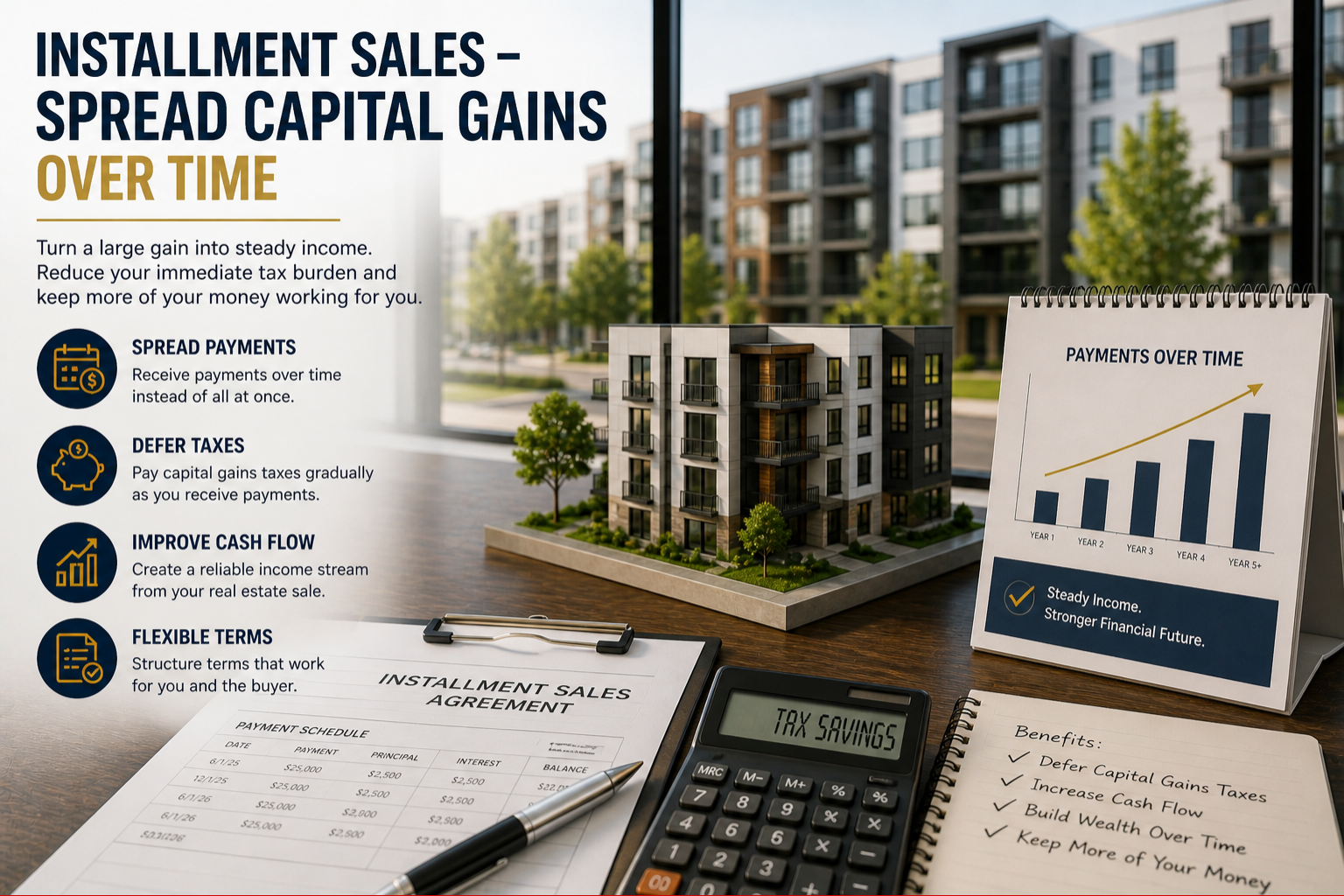
An installment sale, governed by Section 453 of the Internal Revenue Code, allows a real estate seller to recognize capital gains gradually as payments are received, rather than paying all taxes in the year of sale. This method enables sellers to spread out their tax liability over multiple years while receiving steady income from the buyer.
This approach is often compared with strategies like the 1031 exchange, and investors frequently evaluate both using the real estate tax strategy comparison guide to determine the best option. In some cases, installment sales may be combined with Opportunity Zone investments or structured alongside cost segregation to further optimize tax outcomes.
How Installment Sales Work
In an installment sale, the seller provides financing to the buyer instead of receiving the full purchase price upfront. The buyer makes periodic payments—typically including principal and interest—over an agreed timeframe.
Capital gains taxes are paid proportionally as each payment is received, meaning only a portion of the gain is recognized each year rather than all at once.
Tax Benefits of Installment Sales
- Spread capital gains tax liability over multiple years
- Potentially remain in a lower tax bracket
- Manage exposure to Net Investment Income Tax (NIIT)
- Create predictable income streams for retirement
- Integrate with estate planning strategies
Installment Sale vs. 1031 Exchange
| Feature | Installment Sale | 1031 Exchange |
|---|---|---|
| Tax Treatment | Taxes spread over time | Taxes deferred entirely |
| Cash Flow | Ongoing income stream | No immediate income |
| Reinvestment Required | No | Yes (like-kind property) |
| Complexity | Moderate | High |
| Best Use Case | Income planning | Wealth building and reinvestment |
When an Installment Sale Makes More Sense Than a 1031 Exchange
- You want steady income rather than reinvesting
- You are transitioning into retirement
- You prefer simplicity over complex exchange rules
- You want flexibility in structuring payments
- Your goal is tax management rather than full deferral
Risks and Limitations
- Buyer default risk — you rely on the buyer to make payments
- Depreciation recapture may still be taxed upfront
- Related-party transaction rules can limit benefits
- Interest income is taxed separately
- Less immediate liquidity compared to a full sale
Combining Installment Sales with Other Strategies
Installment sales can be combined with other tax strategies to enhance results:
- Use an installment sale alongside a partial 1031 exchange
- Apply installment treatment to any boot received in a 1031 exchange
- Combine with Opportunity Zone investments for additional tax advantages
Frequently Asked Questions
Explore Installment Sale Options Today
Primary CTA:
Explore Installment Sale Options — Free Consultation
Secondary CTA:
Compare Tax Strategies Side-by-Side