
What Is a 1031 Exchange?
A 1031 exchange, named after Section 1031 of the Internal Revenue Code, allows real estate investors to defer capital gains taxes by selling an investment property and reinvesting the proceeds into a like-kind replacement property. When executed properly, this strategy can defer taxes indefinitely, enabling investors to preserve equity and compound wealth across multiple transactions.
To fully understand how exchanges work, investors should review the complete 1031 exchange process, evaluate qualifying property types, and avoid common pitfalls outlined in 1031 exchange mistakes. Many investors also enhance results by combining exchanges with cost segregation strategies.
Many investors completing a 1031 exchange work with experienced commercial real estate brokerage professionals to identify replacement properties that align with their investment and tax-deferral goals.
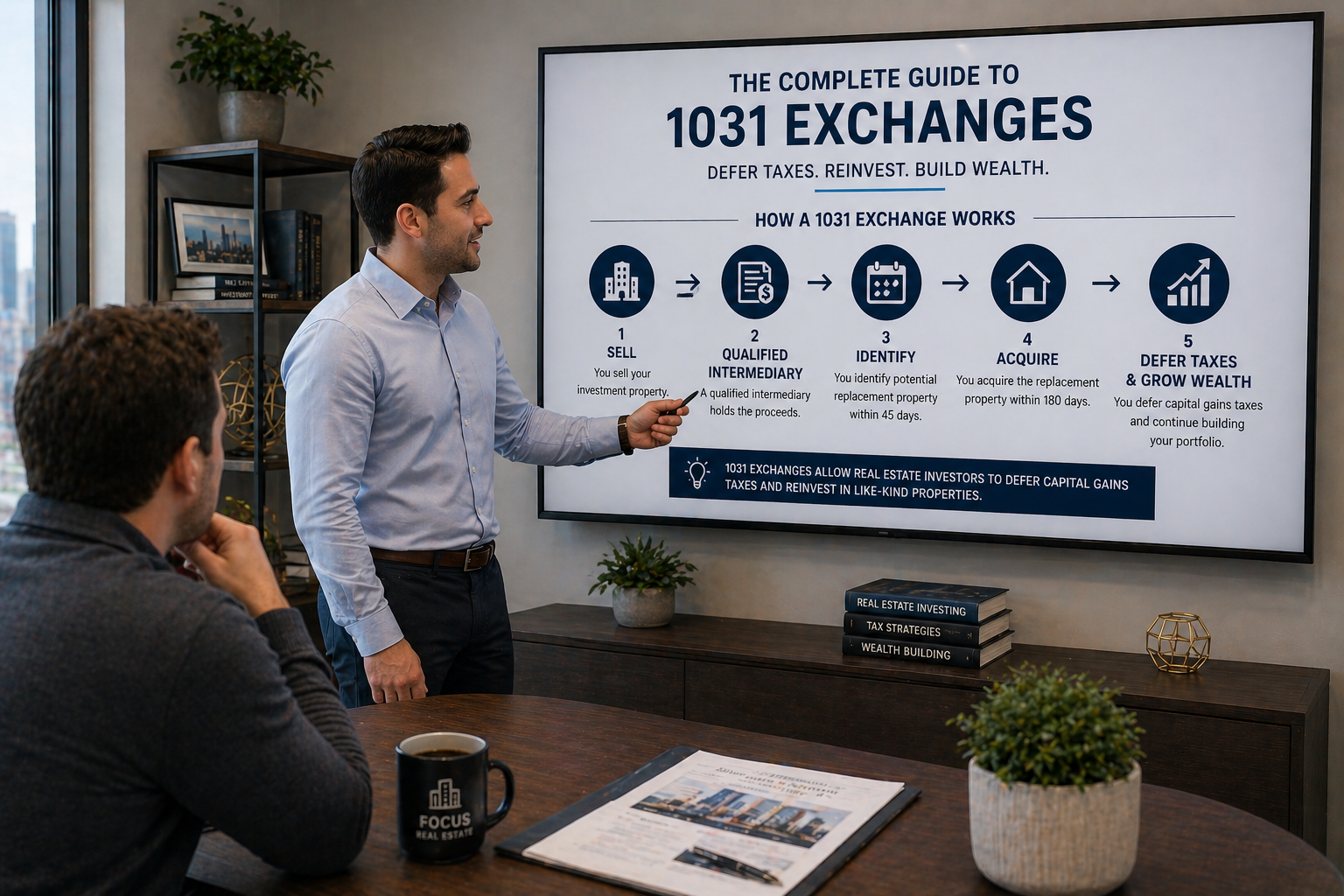
How Does a 1031 Exchange Work?
A 1031 exchange follows a strict IRS-regulated process. Missing a step can invalidate the exchange and trigger taxes.
Step-by-Step Process
- Sell Your Relinquished Property
You close on your current investment property. - Hire a Qualified Intermediary (QI)
The QI holds your funds—you cannot touch the proceeds. - Identify Replacement Properties (Within 45 Days)
You must formally identify potential replacement properties. - Purchase Replacement Property (Within 180 Days)
You must close on one or more identified properties.
Process Visualization (Text Diagram)
Sell Property → Funds Held by QI → Identify (≤45 Days) → Close (≤180 Days)
1031 Exchange Rules & Requirements (2026)
The 45-Day Identification Rule
You must identify replacement properties within 45 calendar days of selling your original property.
You can identify:
- Up to 3 properties (any value)
- OR more under the 200% rule (total value ≤ 200% of sold property)
- OR use the 95% rule (acquire 95% of identified value)
- The 180-Day Closing Deadline
You must complete the purchase within 180 calendar days of the sale.
- This includes weekends and holidays
- No extensions (except rare federally declared disasters)
Like-Kind Property Requirements
“Like-kind” means real estate for real estate, not identical property types.
Qualifying Examples:
- Rental → Apartment building
- Commercial → Land
- Industrial → Retail property
Qualified Intermediary Requirement
A Qualified Intermediary (QI) is mandatory.
- Holds exchange funds
- Prepares legal documents
- Prevents constructive receipt (which disqualifies the exchange)
Equal or Greater Value Rule
To fully defer taxes:
- Buy property of equal or greater value
- Reinvest all net proceeds
- Replace equal or greater debt
Failure results in taxable “boot.”
Types of 1031 Exchanges
Delayed (Starker) Exchange
The most common type.
- Sell first → Buy later
- Must follow 45/180-day rules
Simultaneous Exchange
- Sell and buy on the same day
- Rare due to coordination complexity
Reverse Exchange
- Buy replacement property before selling
- Requires an Exchange Accommodation Titleholder (EAT)
- Useful in competitive markets
Build-to-Suit (Improvement) Exchange
- Use exchange funds to improve property before taking title
- All improvements must be completed within 180 days
What Properties Qualify for a 1031 Exchange?
Only investment or business-use properties qualify.
Eligible Properties
- Rental properties
- Commercial buildings
- Vacant land
- Industrial properties
Not Eligible
- Primary residences
- Second homes (unless converted properly)
- Flips or inventory properties
Common 1031 Exchange Mistakes
Avoid these costly errors:
- Missing the 45-day identification deadline
- Missing the 180-day closing deadline
- Taking control of funds (constructive receipt)
- Not replacing full value → boot taxes
- Improper property identification
- Related-party transactions done incorrectly
- Using property for personal use too soon
1031 Exchange and State Taxes
While 1031 exchanges defer federal capital gains taxes, state treatment varies.
Key Considerations
- Some states track deferred gains (e.g., “clawback rules”)
- Multi-state exchanges can trigger complex filings
- You may owe taxes later if you move states
How DontPayTax.com Supports Your 1031 Exchange
We provide a full-service, investor-focused approach:
- Strategic property identification
- Access to off-market replacement properties
- Licensed brokerage support in 43 states
- Qualified Intermediary coordination
- Deal structuring to maximize tax deferral
- End-to-end closing support
Start Your 1031 Exchange Today
Primary CTA:
Start Your 1031 Exchange Free Consultation
Secondary CTA:
Download the 1031 Exchange Timeline Checklist