
What Does “Like-Kind” Mean?
Under IRS rules, “like-kind” for 1031 exchange purposes means that any real property held for investment or business use can be exchanged for any other real property held for investment or business use. The properties do not need to be identical—only similar in nature or character. This principle is central to understanding what property types qualify and how flexible exchange structuring can be.
This means you can exchange a rental house for a commercial building, vacant land for farmland, or an apartment complex for an industrial property, as long as both properties are held for investment or business purposes. Investors often combine this flexibility with strategies outlined in the real estate tax strategy comparison guide or use alternatives like DST investments when direct ownership is not ideal, while avoiding errors highlighted in common 1031 exchange mistakes.
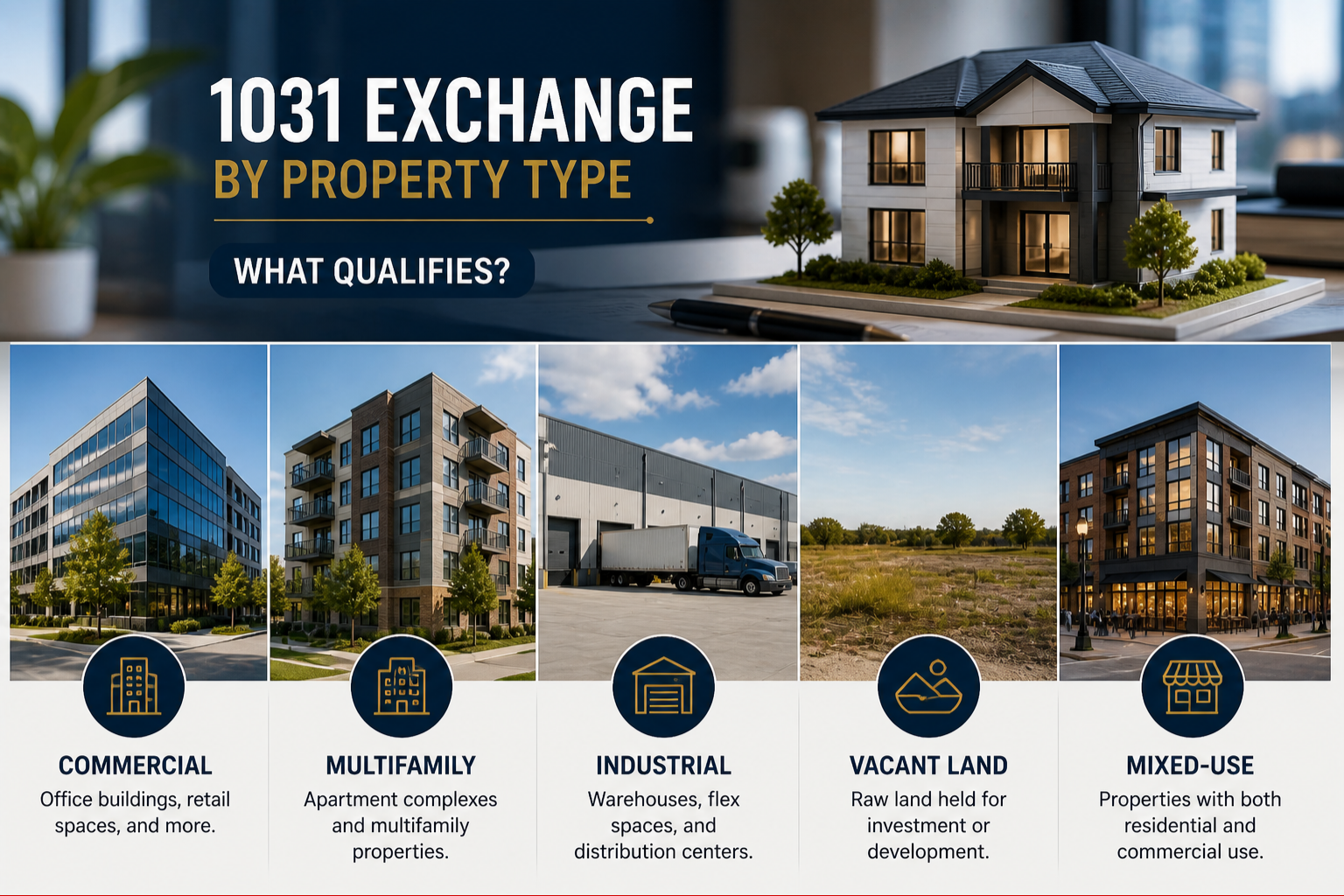
Property Types That Qualify
Rental Properties (Single-Family & Multifamily)
Rental properties are one of the most common assets used in 1031 exchanges. Both single-family rentals and multifamily properties qualify as long as they are held for investment purposes.
Commercial Properties (Office, Retail, Industrial)
Office buildings, retail centers, warehouses, and industrial properties all qualify for 1031 exchanges. These properties are often exchanged to scale portfolios or improve cash flow.
Vacant Land & Development Sites
Vacant land held for investment qualifies for a 1031 exchange. Investors often exchange developed properties into land or vice versa, depending on their strategy.
Farms & Agricultural Property
Farmland, orchards, and agricultural land qualify as like-kind real estate. Investors can exchange farmland into other real estate types, including commercial or residential investment properties.
Equestrian Properties & Ranches
Equestrian facilities, ranches, and similar specialty properties qualify if they are held for business or investment purposes.
Mixed-Use Properties
Properties that combine residential and commercial use—such as retail with apartments above—qualify as long as they are primarily used for investment.
DST Interests (Fractional Real Estate)
Delaware Statutory Trust (DST) interests qualify as replacement property in a 1031 exchange, allowing investors to move into fractional ownership of institutional-grade assets.
Property Types That Do NOT Qualify
- Primary residences
- Second homes (unless converted to investment use)
- Fix-and-flip or inventory properties
- Partnership interests (with limited exceptions)
- Foreign real estate exchanged for U.S. property
Cross-Type Exchanges — Can I Swap Property Types?
Yes. One of the most powerful aspects of a 1031 exchange is flexibility. You can exchange between completely different types of real estate:
- Apartment building → vacant land
- Rental home → commercial office
- Farm → industrial warehouse
As long as both properties are held for investment or business use, the exchange qualifies under like-kind rules.
Mr. Biggs Advantage: Brokerage + Exchange in 43 States
Finding the right replacement property is critical to a successful exchange. With access to commercial, land, agricultural, and specialty property listings across 43 states, DontPayTax.com and its brokerage network help investors identify and secure qualifying replacement properties efficiently.
Frequently Asked Questions
Find Qualifying Properties Today
Primary CTA:
Find Qualifying Replacement Properties — Call 877-MR-BIGGS
Secondary CTA:
Start Your 1031 Exchange — Free Consultation